
Foreign investors' share of short-selling turnover across both markets rose from 59.43 percent in September to 70.37 percent in October and 74.98 percent this month through Wednesday, the highest this year. Samsung Electronics and SK hynix together accounted for 20.6 percent of KOSPI short-selling turnover this month, prompting calls from retail investors for a temporary short-selling ban.
Tags: South Korea, KOSPI, KOSDAQ, Short Selling, Foreign Investors, Retail Investors, Samsung Electronics, SK hynix, Korea Exchange, KRX, Korean Stocks, Stock Market, Financial Markets, Semiconductor

Kim Hee-su
Kim Hee-su is a bilingual reporter at AJU Press, covering defense and foreign affairs. Before joining AJP in 2025, she worked at The Korea Times, where she wrote interview stories, including a profile of North Korean defector Kim Gum-hyok, and produced digital content. She also previously worked as a researcher for KBS News 9’s International News Department, supporting correspondents in 10 countries around the world. She graduated from the University of Toronto in Canada with a double major in Book and Media Studies and East Asian Studies.
Copyright ⓒ Aju Press All rights reserved.
Related News
-
 More than 70% of Suspected Illegal Short Selling Cases Uninvestigated
불법 공매도 의심 거래를 적발하기 위해 도입한 공매도 중앙점검시스템(NSDS)이 가동된 이후 금융당국에 통보된 규제 위반 의심 사례 10건 중 7건 이상이 조사조차 시작되지 못한 것으로 나타났다. 19일 국회 정무위원회 금융감독원 국정감사에서 박민규 더불어민주당 의원은 공매도 중앙점검시스템 도입 이후 통보된 규제 위반 의심 사례 상당수가 조사에 착수하지 못하고 있다며 감독당국의 대응을 촉구했다. 박 의원이 한국거래소와 금감원에서 제출받은 자료에 따르면 지난해 3월 31일 NSDS 가동 이후 금융당국에 통보된 공매도 규제 위반 의심 사례는 총 95건으로 집계됐다. 이 가운데 71건(74.7%)은 조사가 시작되지 않은 상태다. 연도별로 보면 지난해 통보된 58건 가운데 35건(60.3%)이 조사 미착수 상태다. 올해 통보된 37건 중에서는 36건(97.3%)이 조사에 착수하지 못했고, 조치가 완료된 사례는 한 건도 없었다. 전체 95건 가운데 조사가 진행 중인 사례는 14건, 조치가 완료된 사례는 10건으로 파악됐다. 조치 완료 건의 처리 결과는 무혐의 4건, 조치면제 5건, 과징금 부과 1건이었다. NSDS는 한국거래소가 기관투자자의 공매도 잔고와 거래정보, 매매주문 내역 등을 대조해 무차입 공매도 등 규제 위반 의심 거래를 찾아내는 시스템이다. 거래소가 의심 사례를 금융당국에 통보하면 금감원이 후속 조사를 진행하는 구조다. 그러나 금감원의 공매도 관련 조사 인력은 총 9명에 불과하며 이 가운데 전담인력은 7명인 것으로 파악됐다. 금감원은 NSDS를 통해 통보된 사건뿐 아니라 다른 공매도 위반 혐의 사건과 자진신고, 테마점검 등도 담당하고 있어 조사에 상당한 시간이 소요되는 상황이다. 박 의원은 "우리 정부가 불법 공매도를 잡겠다고 중앙점검시스템까지 구축해 놨는데 적발 혐의를 제때 조사하지 못하면 무슨 소용이 있겠느냐"며 조사 인력 확충 등 적극적인 조치를 요구했다. 이에 이찬진 금융감독원장은 금융위원회에 인력 충원을 요청하겠다고 답했다.* This article has been translated by AI.
-
 Seoul court upholds record fine on UBS over naked short selling
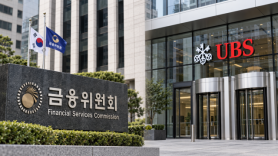
ChatGPT generated image of FSC and UBS. SEOUL, September 05 (AJP) -A South Korean court has upheld a 16.94 billion won ($12.2 million) penalty imposed on Credit Suisse for naked short selling, rejecting UBS's argument that shares used as collateral remained under the investment bank's ownership. The Seoul Administrative Court recently ruled against UBS in a lawsuit seeking to overturn the penalty imposed by the Securities and Futures Commission (SFC), according to legal sources Friday. UBS inherited the case after acquiring Credit Suisse. The SFC, which operates under the Financial Services Commission, imposed the penalty in July 2024 after finding that Credit Suisse had sold 60.33 billion won worth of shares it did not own in violation of South Korea's Capital Markets Act. Including penalties imposed on Credit Suisse affiliates, the total reached about 27.1 billion won, the largest since South Korea introduced a penalty surcharge system for naked short selling in 2021. Short selling generally involves borrowing shares and selling them in anticipation of buying them back later at a lower price. Selling shares without first borrowing them, known as naked short selling, is prohibited in South Korea. UBS challenged the regulator's decision, arguing that the shares involved were not ordinary borrowed stock but shares provided as collateral to domestic securities firms. The company maintained that Credit Suisse had retained ownership of the shares and therefore could not be considered to have sold stock it did not possess. UBS also argued that even if the transactions constituted short selling, Credit Suisse could have recovered the shares before settlement through a recall, or a request for early return, meaning the sales should not be treated as naked short positions. The court rejected both arguments. Judges found that the fact that shares were provided as collateral did not automatically mean ownership remained with Credit Suisse. The purpose of providing collateral and the legal ownership of the shares were separate questions, the court said, adding that ownership depended on the contractual terms and legal structure agreed between the parties. The court concluded that ownership had transferred when Credit Suisse provided the shares to domestic securities firms and that selling them before they were returned constituted short selling. It also dismissed UBS's contention that a recall would have ensured the shares were available by settlement. A request for early repayment did not provide a firm guarantee that the shares would actually be returned before the settlement deadline, the court found. UBS separately argued that the size of the penalty lacked sufficient basis and was excessive. The court rejected that claim as well, noting that the original penalty had been calculated at about 33.89 billion won before regulators reduced it by 50 percent. The reduction reflected factors including that the short-selling transactions occurred before UBS's merger with Credit Suisse. The court said the final 16.94 billion won penalty could not be considered excessive relative to the violation. UBS could not be reached for comment.
-
Short Selling Rises Amid Stock Price Surge, Investors Divided
Recent data shows that short selling balances have increased for certain stocks that have seen significant price surges. Despite rising stock prices, the expansion of short positions indicates that investors are anticipating future declines, complicating their calculations regarding these rapidly increasing stocks.According to the Korea Exchange, as of August 19, the most recent tally, the net short selling balances for some stocks that experienced price increases compared to the end of last month have also risen.In the KOSPI, Doosan Fuel Cell stood out with a notable increase. The stock price rose from 24,550 won at the end of last month to 39,800 won on August 19, marking a 62.1% increase. During the same period, the net short selling balance surged by 182.1%, from over 510,000 shares to 1,440,923 shares. The proportion of short selling balances relative to market capitalization also expanded from 0.78% to 2.20%, an increase of 1.42 percentage points.Similarly, Isu Petasys saw its stock price rise from 74,500 won to 104,400 won, a 40.1% increase, with its net short selling balance increasing by 96.1%. Doosan Enerbility also experienced a 13.6% rise in stock price, while its short selling balance grew by 72.4%.LG Electronics also reported increases in both stock price and short selling balances. The stock price rose from 162,100 won at the end of last month to 201,500 won on August 19, a 24.3% increase. During this period, the net short selling balance increased by 66.6%, and the proportion of short selling balances relative to market capitalization rose from 0.79% to 1.31%.In the KOSDAQ, stocks that have recently surged also showed an increase in short selling balances.Taesung's stock price jumped from 31,250 won at the end of last month to 51,900 won on August 19, a 66.1% increase. The net short selling balance rose by 49.5%, from 1,066,175 shares to 1,593,575 shares. The proportion of short selling balances also increased from 3.49% to 5.22%, a rise of 1.73 percentage points.Robotics firm Roboteers saw its stock price increase from 183,800 won to 267,000 won, a 45.3% rise. Its net short selling balance grew by 39.7%, from 424,673 shares to 593,358 shares, with the balance proportion expanding from 2.90% to 4.05%.Similarly, Clobot's stock price rose from 23,200 won to 30,850 won, a 33.0% increase. The net short selling balance increased by 74.1%, from 729,352 shares to 1,270,027 shares, with the balance proportion rising from 2.87% to 4.99%.The increase in short selling balances may reflect the rising valuation due to stock price increases. However, these stocks have seen an actual increase in net short selling balances, and the proportion relative to market capitalization has also risen. This indicates that short positions have expanded even as stock prices have risen.A securities industry official noted, "Typically, when stock prices rise sharply in a short period, investors may perceive limited potential for further increases, leading to an influx of short selling demand. However, an increase in short selling balances does not necessarily lead to a decline in stock prices, so it is essential to consider individual stock performance, valuations, and supply and demand factors as well."According to Kang Song-cheol, a researcher at YuJin Investment & Securities, "Historically, after a surge in short selling, indices often rebound after a delay. If the short selling ratio does not spike again, it is possible that the peak of selling pressure has passed."* This article has been translated by AI.