
The proportion of unmarried people in their 30s reached 53.1 percent in 2025, up from 42.5 percent in 2020 and nearly four times the 13.4 percent recorded in 2000, according to the Ministry of Data and Statistics (MODS).
Among men in their 30s, 61.1 percent had never married, compared with 44.3 percent of women. The corresponding figures in 2000 were just 19.2 percent and 7.5 percent, respectively.
The gender gap was also evident across age groups. While 52.7 percent of women in their 30s had a spouse, men were more likely to be single than married until their 40s. Among men in their 40s, 66.7 percent had a spouse and 27.7 percent had never married.
Yet the figures do not necessarily reflect a lack of interest in marriage.
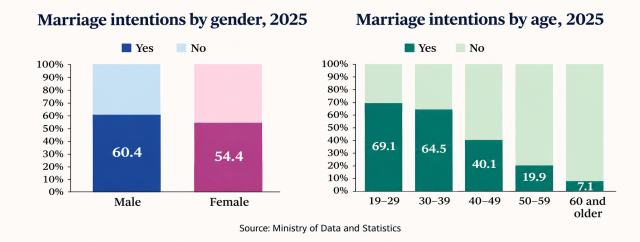
Of the 11.93 million never-married adults aged 19 and older, 6.9 million, or 57.8 percent, said they planned or wanted to marry. The proportion was higher among men at 60.4 percent than women at 54.4 percent.
Interest in marriage declined with age, from 69.1 percent among those aged 19–29 to 64.5 percent among those in their 30s. The figure fell to 40.1 percent among those in their 40s.
Those with jobs were also more inclined to marry. Among those who had never been married, 60.5 percent of those working expressed an intention to marry, compared with 52.3 percent of those not working.
Women meanwhile were less inclined than men to have children.
Among people aged 19 to 49, just 35.4 percent expressed an intention to have children. The figure stood at 39.8 percent for men and 30.9 percent for women.
Childbearing intentions also varied by marital status, with 50.1 percent of never-married respondents planning or wanting to have children, compared with 18.7 percent of those who had been married, including people who were divorced or widowed.
The census also pointed to a growing proportion of women without children.
Among ever-married women aged 15 and older, 10 percent had never given birth, compared with 4 percent in 2010. The average number of children born to these women fell to 2.0 from 2.1 in 2020.
Among ever-married women aged 19–49, the expected number of children stood at 1.61, including 1.38 already born and 0.23 they planned to have.
Even among those in the age group who had never given birth, 55.9 percent had no plans to have children.
The census also highlighted the impact of marriage and motherhood on women's careers. Among married women aged 20 and older who had worked before marriage, 80.6 percent had left a job at some point for reasons including marriage, pregnancy, childbirth or childcare. The proportion was down 1.6 percentage points from 2020.
Marriage accounted for 46.8 percent of those career interruptions, followed by pregnancy and childbirth at 29.7 percent. Among women in their 30s and 40s, however, pregnancy and childbirth were the leading reasons, accounting for 42.4 percent and 42.5 percent, respectively.
Meanwhile, reliance on childcare outside the family increased. Some 63.9 percent of children aged 12 and younger received daytime care from people or facilities outside the family, up 13.3 percentage points from 2020. For the first time since 2015, the figure was higher than that for family-based care, which stood at 61.4 percent.
Despite a 20.7 percent decline in the number of children aged 12 and younger over the five-year period, the number attending after-school programs and private academies for daytime care rose 63.8 percent and 16.5 percent, respectively.
Parents remained the most common caregivers at 50.3 percent. Private academies and daycare centers followed at 23.1 percent and 16.6 percent, respectively. The survey allowed respondents to report up to two childcare arrangements.
The findings were based on a survey of 20 percent of households nationwide as of Nov. 1, 2025, conducted as part of South Korea's five-year population and housing census.
Tags: South Korea marriage trends, 2025 Population and Housing Census, South Korea marriage intentions, South Korea low birth rate, Women's career interruptions in Korea
Ryu Yuna
Yuna Ryu covers finance, capital markets and Southeast Asian affairs.
She is drawn to the questions that numbers raise and the stories that data alone cannot answer.
Prior to journalism, she worked at Hyundai Motor Company and the Singapore Chamber of Commerce, focusing on business strategy and international affairs. She has also hosted diplomatic receptions and international conferences as an MC.
Ryu holds a master's degree in Media and Communication from Korea University, where her research focused on neuroscience-based studies of media effects.
Copyright ⓒ Aju Press All rights reserved.
Related News
-
 Three South Koreans earn spots on next year's LPGA Tour
SEOUL, November 24 (AJP) - South Korean golfers Kim Min-sun, Yoo Hyun-jo and Lee Da-yeon have secured spots on next year's LPGA Tour after finishing among the top 25 at its qualifying tournament in Mobile, Alabama on Monday. Kim led the South Korean qualifiers, finishing fourth at 21-under-par 337 at the final round of the LGPA Q-Series. Yoo, a three-time winner on the KLPGA Tour this season, placed 22nd at 14-under 344, while Lee finished 23rd at 13-under 345, just one stroke above the qualifying cutoff. A total of 27 players earned tour cards, with five players tied for 23rd. Tags: LPGA Tour, LPGA Q-Series, South Korean golfers, Alabama
-
210,000 Koreans Visit California as Local Tourism Industry Strengthens Focus on Korean Market
The California tourism industry is accelerating its efforts to target the Korean market. With Korean tourists ranking seventh among major overseas markets visiting California, local tourism companies have traveled to South Korea to discuss new product development and strategies to attract more tourists.Twenty local businesses, including the California Tourism Board, hotels, and theme parks, participated in the 'Trade & Media Mission 2026' held in Seoul from November 12 to 13. This event, which took place for the first time in two years, saw approximately 150 attendees, including representatives from domestic travel agencies, airlines, and media.The California Tourism Board's focus on the Korean market is driven by the spending power of Korean tourists. According to the board, 209,144 Koreans visited California from January to September this year, ranking seventh among overseas markets, excluding Canada and Mexico.According to Tourism Economics, a global tourism industry analysis firm, 62% of Koreans considering travel to California are high-spending tourists, which is 14 percentage points higher than the average for all overseas leisure travelers (48%).Spending by Korean tourists in California is also expected to rise. It is projected to increase from approximately $814 million this year to $892 million next year, marking a 9.6% increase. Despite factors such as currency fluctuations and rising fuel surcharges that can burden long-distance travel, analysts believe the spending potential of Korean tourists remains high.The event also emphasized practical discussions for tourism product development. On November 12, about 26 product managers from major domestic travel agencies conducted one-on-one consultations with local businesses. The following day, senior executives from travel agencies focused on the Americas participated to discuss product composition and sales expansion strategies.Local participants included tourism boards from Los Angeles, San Diego, Anaheim, Santa Monica, and Monterey, as well as Universal Studios Hollywood, the San Diego Zoo Wildlife Alliance, Citadel Outlets, and Hertz. A variety of travel content was introduced, ranging from city tourism to theme parks, nature and eco-tourism, shopping, and car rentals.On November 13, a separate media program was conducted for about 56 domestic media representatives and influencers. Participating companies introduced their regional tourism resources and travel content while discussing promotional strategies aimed at the Korean market.Dinners and luncheons were also organized for key figures in the travel industry. Notably, a program showcasing California wines alongside Korean cuisine was held to celebrate the 50th anniversary of the 1976 'Judgment of Paris,' where California wines gained recognition in a blind tasting against French wines.The California Tourism Board plans to enhance cooperation with the Korean travel industry while strengthening the provision of local tourism information. Recently, it revamped its Korean-language media center to provide regional tourism news, travel content, and press materials. This initiative aims to improve information accessibility for domestic travel agencies and media, thereby expanding the attraction of Korean tourists.* This article has been translated by AI.
-
 AI goes mainstream as 1 in 3 Koreans use ChatGPT
Edited and compiled by AJP. Graphics AI-assisted. SEOUL, November 08 (AJP) - More than a third of South Koreans used ChatGPT on their phones in October, a sign that artificial intelligence chatbots have moved from novelty to a routine part of daily life. ChatGPT's mobile app recorded 18,762,276 monthly active users in South Korea last month, according to data released Sunday by Mobileindex, an app analytics service run by IGAWorks. That was in a country of about 51.8 million people, according to the 2025 census by the Ministry of Data and Statistics. The figure measures users who opened the app at least once during the month. It was the first above 18 million since Mobileindex began tracking the app. ChatGPT's user base grew 43.8 percent from 13.05 million a year earlier and 4.3 percent from 17.99 million in September. People also spent far more time with the app. Total usage reached about 50.98 million hours in October, up 113.9 percent from about 23.83 million hours a year earlier and well ahead of the growth in users. The average user spent about 163 minutes on ChatGPT during the month, 53 minutes more than in October 2025. ChatGPT, developed by U.S. company OpenAI, accounted for about 91 percent of users of the AI apps Mobileindex tracks, up from about 84 percent a year earlier. Many users now run several services side by side. Jeong Gu-jeong, a 44-year-old business owner, splits her work among ChatGPT, Claude and Gemini. "I find Claude most useful for paperwork and planning," Jeong said. "AI helps me get through chores faster, which used to take me a long time because I run a one-person company." Claude, made by U.S. AI company Anthropic, saw its monthly users rise about 15-fold to about 2.1 million from about 139,000 a year earlier. The jump lifted it from seventh to second place among AI apps tracked by Mobileindex. Claude users also stayed longer. Total usage reached about 3.88 million hours, 22 times the level a year earlier, while average time per user rose from about 75 minutes to 111 minutes. Other services lost ground. A., SK Telecom's AI assistant, had about 1.07 million monthly users, down 42.5 percent from a year earlier. Perplexity fell 30.9 percent to about 569,000, while Elon Musk's Grok rose 6.8 percent to about 517,000. The figures cover only Android and iOS app use in South Korea and exclude web access. Mobileindex said Google's Gemini can also be reached through the Google app, so the data may not reflect its full usage. ChatGPT led new installs in October with about 790,000, though that was 16.2 percent fewer than a year earlier. Claude came second with about 490,000, 13 times its total from October 2025.