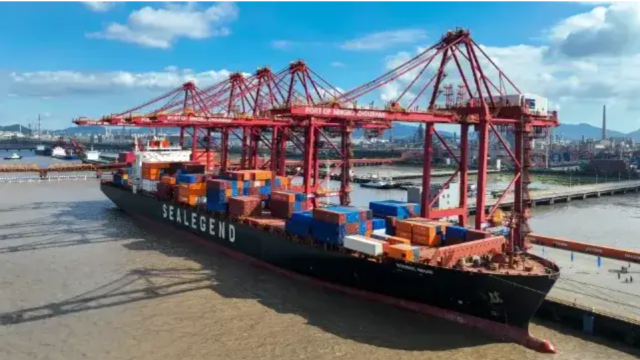
Chinese carrier Sea Legend will begin operating a scheduled container service this week between Ningbo in eastern China and Felixstowe in the United Kingdom, the Financial Times reported Monday.
The company has scheduled eight fixed sailings between August and October connecting Ningbo with Felixstowe, Rotterdam in the Netherlands and Hamburg in Germany.
Sea Legend, which mainly operates small and midsized container ships, plans to use the Arctic route primarily to transport electric vehicles, lithium batteries and solar products to Europe.
The route could cut the voyage between China and Europe to about 20 days, depending on Arctic conditions, roughly half the approximately 40 days required on conventional routes.
The move comes as climate change continues to reduce Arctic sea ice, opening the region to more commercial shipping during the summer months.
A record 23 vessels transited the Northern Sea Route in summer 2025, up from 15 in 2024. During the summer navigation season, sea ice can retreat far enough north to allow some vessels without icebreaking capabilities to make the passage.
Interest in the Arctic route has also increased as shipping companies seek alternatives to traditional maritime chokepoints facing heightened geopolitical risks.
Following attacks by Yemen's Iran-backed Houthis on two Saudi oil tankers in the Red Sea on July 23, global oil prices climbed back above $100 per barrel.
The Arctic route allows vessels traveling between Asia and Europe to avoid the Red Sea and other chokepoints along the conventional route.
However, Danish shipping giant Maersk has said it does not intend to use the Arctic route, citing concerns over potential damage to the region's fragile ecosystem.
According to an analysis by Allianz, more than 500 shipping accidents were reported in the Arctic region over the past decade, with mechanical damage or failure accounting for roughly half of the incidents.

Copyright ⓒ Aju Press All rights reserved.