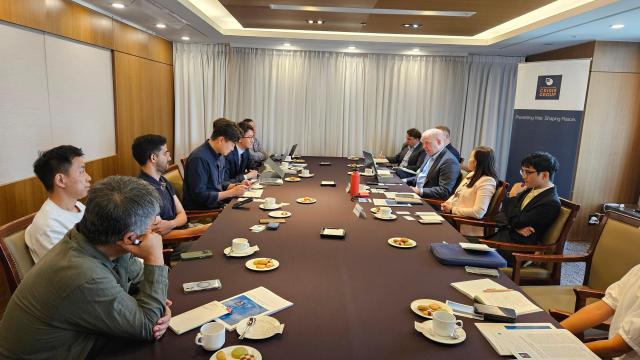
SEOUL, September 30 (AJP) - A recent land mine explosion in the Demilitarized Zone has underscored the risk of unintended escalation between the two Koreas at a time when Seoul and Washington are exploring renewed diplomacy with Pyongyang, experts at the International Crisis Group said Wednesday.
Christopher Green, senior adviser for the Korean Peninsula at Crisis Group, said there was only so much South Korea could do in response to the incident, which occurred on Sept. 21 south of the Military Demarcation Line and injured three South Korean soldiers, two of them seriously. South Korea’s military has said North Korean mines were highly likely to have caused the explosions.
“Accidental escalation is always just a few steps away,” Green said at a Crisis Group media briefing in Seoul.
The remarks came during a Crisis Group media briefing titled “South Korea in Asia’s Security Shake-Up,” held in Seoul on Wednesday. The discussion examined South Korea’s position amid shifting regional security dynamics, including North Korea’s growing military relationship with Russia, China’s renewed engagement with Pyongyang, tensions over Taiwan, the South Korea-U.S. alliance and the prospects for renewed diplomacy with Kim Jong-un.
Green said the incident should be seen against Pyongyang’s broader effort to harden the inter-Korean border following North Korean leader Kim Jong-un’s declaration that the two Koreas are hostile states.
North Korea has laid mines, erected barriers and carried out other fortification work along the border in recent years.
Green warned that the lack of meaningful communication between the two Koreas leaves open the possibility that a border incident could spiral beyond what either side intends.
The United Nations Command said Wednesday that a North Korean antipersonnel mine had been discovered south of the Military Demarcation Line during a joint investigation with the South Korean military and determined that the incident constituted a violation of the Korean War armistice.
North Korea, however, denied responsibility for the blast. Kim Yo-jong, the influential sister of Kim Jong-un, dismissed Seoul’s investigation as a “farce” and warned that Pyongyang would retaliate if South Korean troops opened fire on North Korean forces conducting work near the border.
Green said South Korea had become a “very powerful military country” and had performed well in several key areas, while describing the Lee Jae Myung administration’s emphasis on “pragmatic diplomacy” as, so far, “more buzzword than substance.”
Asked by AJP how the DMZ explosion could affect inter-Korean relations and the prospect of another summit between U.S. President Donald Trump and Kim, Green cautioned against placing too much weight on diplomatic rhetoric.
“Words are one thing and actions are the other,” he said.
Trump has expressed interest in meeting Kim again, reviving speculation about a possible return to the leader-level diplomacy that produced summits in Singapore, Hanoi and the inter-Korean border village of Panmunjom during Trump’s first term.
Green said any renewed engagement would have to take into account how much the strategic environment has changed since those meetings, including Pyongyang’s closer relationship with Moscow and its hardened stance toward Seoul.
North Korea’s military relationship with Russia also featured prominently in Wednesday’s briefing.
Asked by AJP whether Moscow had given Kim enough economic, military and diplomatic room that he no longer needed better relations with Seoul or Washington, Green said North Korea’s long-term strategic priority has been diversification.
“Diversity brings security,” he said, arguing that Pyongyang has historically sought relationships with multiple powers rather than becoming excessively dependent on a single partner.
He said North Korea could eventually seek to diversify again if changing geopolitical conditions made its heavy reliance on Russia less advantageous.
Crisis Group analysts also discussed China’s role in any future diplomatic opening with Pyongyang. William Yang said Beijing had become more proactive toward North Korea after years of relatively strained leadership-level relations under Chinese President Xi Jinping.
Yang noted that recent diplomatic signals had included less emphasis on denuclearization, which he described as a carefully calculated gesture toward Pyongyang. He also pointed to the absence of North Korean denuclearization language in the U.S. readout of the recent Trump-Xi summit as a development worth watching.
The International Crisis Group is an independent, non-profit and non-governmental organization focused on preventing and resolving deadly conflict through field-based research and policy advocacy. Founded in 1995, the organization deploys analysts in or near conflict-prone regions and produces policy recommendations for governments and international organizations.
Wednesday’s discussion also touched on a potential Taiwan contingency, South Korea’s relations with China and Japan, the future of regional military cooperation and the implications of North Korea’s expanding ties with Russia.
Despite South Korea’s growing military capabilities, Green said the DMZ explosion illustrated a fundamental constraint facing Seoul because it cannot fully control developments originating on the northern side of the border.
That leaves crisis management and communication particularly important, he said, as the two Koreas confront one another across one of the world’s most heavily fortified frontiers.
AJP Takeaways
- A recent DMZ mine explosion has heightened concerns over unintended escalation between the two Koreas, with Crisis Group expert Christopher Green warning that accidental escalation remains “always just a few steps away.”
- Green said Seoul has limited options when incidents originate from North Korea, even as South Korea has become a “very powerful military country” and the Lee Jae Myung administration pursues what it calls pragmatic diplomacy.
- Crisis Group experts said any renewed Trump-Kim Jong-un diplomacy would unfold in a markedly different environment, shaped by North Korea’s deeper ties with Russia, Beijing’s renewed engagement with Pyongyang and the breakdown of inter-Korean communication.
Copyright ⓒ Aju Press All rights reserved.