
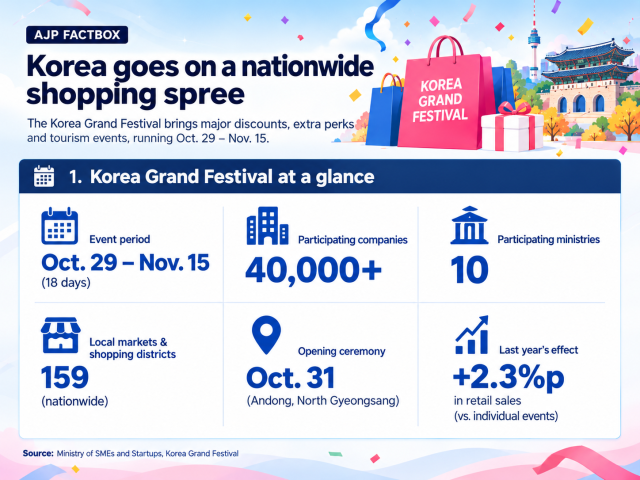
The Korea Grand Festival, a government-led nationwide shopping event that brings together major retailers, small businesses and tourism operators to boost domestic spending, will run for 18 days from Oct. 29 to Nov. 15.
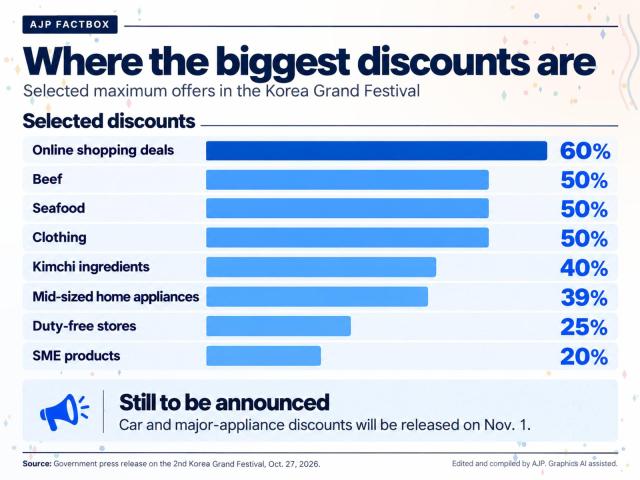
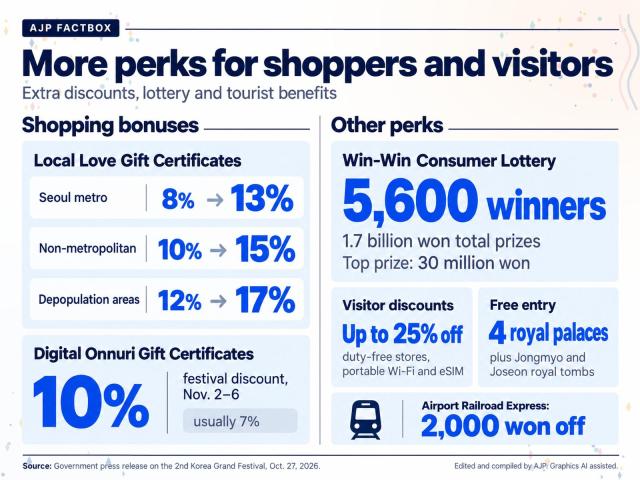
More than 40,000 companies will take part, offering discounts of up to 60 percent on selected online shopping deals and up to 50 percent on beef, seafood and clothing. Shoppers can also get extra discounts on local gift certificates and enter a lottery offering 1.7 billion won ($1.28 million) in prizes, while foreign visitors can enjoy duty-free discounts and free admission to major royal heritage sites.

Yuna Ryu covers finance, capital markets and Southeast Asian affairs.
She is drawn to the questions that numbers raise and the stories that data alone cannot answer.
Prior to journalism, she worked at Hyundai Motor Company and the Singapore Chamber of Commerce, focusing on business strategy and international affairs. She has also hosted diplomatic receptions and international conferences as an MC.
Ryu holds a master's degree in Media and Communication from Korea University, where her research focused on neuroscience-based studies of media effects.
Copyright ⓒ Aju Press All rights reserved.
Related News
-
 NS Home Shopping CEO Jo Hang-mok Receives Innovation Management Award
Jo Hang-mok, CEO of NS Home Shopping, has been awarded the Innovation Management Award by the Korean Management Association for his achievements in consumer-centric service innovation and enhancing business competitiveness through artificial intelligence (AI) technology.NS Home Shopping announced on November 12 that Jo received the award in the innovation service category during the '2026 Korean Management Association Fall Academic Conference' held on November 11. Since taking office in 2021, Jo has focused on consumer trust as a core management value, striving to improve product and service quality. This year, marking the company's 25th anniversary, he set a vision of becoming the 'Customer Number One Food & Life Shopping Platform' and has promoted organizational culture improvements and business structure innovations. The advancement of services utilizing AI and digital technology has been highlighted as a key achievement. NS Home Shopping has enhanced its product recommendation features based on consumer purchase history and preferences, while also improving its broadcasting infrastructure and operational systems. The integration of AI technology across its operations has increased organizational efficiency. The company is also expanding into offline retail. In June, NS Home Shopping initiated the acquisition of Homeplus Express, seeking to diversify its business structure beyond traditional home shopping. Looking ahead, NS Home Shopping plans to utilize its store network as a channel for fresh food sales and as a logistics hub, aiming to establish a distribution model that connects online and offline shopping. The company has also focused on fostering mutual growth with partner companies, supporting small and medium-sized enterprises in product development and market expansion, while discovering and promoting local agricultural products and small business goods. Based on consumer-centered management (CCM), NS Home Shopping has improved service quality from product planning to delivery and after-sales service, while also expanding the use of eco-friendly packaging and engaging in community contribution activities. Jo stated, "In the rapidly changing retail environment, I feel a greater sense of responsibility as continuous innovation and new challenges are required. In the future, we will continue to provide differentiated shopping experiences to consumers based on AI technology and content competitiveness, grow alongside our partner companies, and develop into a company that adds real value to consumers' lives." Additionally, on November 11, NS Home Shopping held a 'Rice Cake Sharing' event in the lobby of its Pangyo headquarters, delivering 1,000 sets of rice cakes made from domestically produced rice to promote local rice consumption. * This article has been translated by AI.
-
Korea and China Discuss Tourism Industry Changes in Beijing
Officials from tourism research institutions and industries in South Korea and China gathered to discuss policies and cooperation strategies to respond to changes in the tourism industry. Key topics included tourism services utilizing artificial intelligence (AI) and digital technology, regional consumption by foreign tourists, and shopping and industrial tourism.The Korea Culture and Tourism Institute announced that it held the 13th Korea-China Tourism Cooperation Seminar in Beijing on November 12.The seminar, themed "Innovation in the Tourism Industry and Policy Support," featured researchers from national tourism research institutions in both countries, as well as representatives from Chinese companies such as DiDi and Yili Group.South Korean researchers presented findings focusing on the impact of changes in the tourism industry and foreign tourist spending on local economies. Song Soo-yeop, a deputy researcher at the Korea Culture and Tourism Institute, discussed trends in the new tourism industry and policy responses, while Kang Ji-soo, another deputy researcher, analyzed the effects of spending by foreign tourists in local areas.Chinese researchers addressed topics such as the development of inland water tourism and the impact of foreign tourists' shopping consumption on local economies. Cui Xin from the China Tourism Academy presented policies for fostering inland water tourism, while Ma Xiao-feng discussed the spatial ripple effects of inbound shopping consumption and the structure of consumption transitions.Examples of tourism business initiatives were also shared. The Chinese mobility company DiDi presented cases of Korea-China tourism exchanges utilizing digital transportation services, while the dairy company Yili Group shared its experiences in industrial tourism operations.Following the presentations, representatives from Shilla Duty Free and Jeju Air participated in discussions about current issues in the tourism industries of both countries and potential avenues for cooperation.Hwang Kyo-ik, director of the Korea Culture and Tourism Institute, stated, "Both institutions share the common task of responding to changing tourism demands between Korea and China, supporting the growth of a converged tourism industry, and expanding tourist consumption through policy research. We will continue our collaborative research to enhance tourism exchanges and policy development, as we have done for the past 13 sessions."* This article has been translated by AI.
-
China's AI Shopping Expands Rapidly as Chatbot Transactions Surpass 5%
Online shopping utilizing artificial intelligence (AI) is rapidly expanding in China.According to Reuters on November 12, purchases made through AI chatbot links on the short-form video and social commerce platform Douyin accounted for approximately 5% of total purchases in October. For items like health supplements, where consumers typically review product information thoroughly before buying, the share of purchases via AI chatbots exceeded 20%. This data was sourced from market research firm WPIC Marketing and Technologies.This trend indicates that Chinese consumers are beginning to use AI not just as a tool for information searches but as a shopping assistant. For instance, consumers can describe their desired product specifications and budget to the AI chatbot and request comparisons of prices and features across various products. An example might be asking the AI to find a washing machine that fits in a narrow balcony and operates quietly at night within a specific budget. The AI not only recommends suitable products but also guides users through discounts, promotional events, and payment benefits, supporting them throughout the purchasing process.Jacob Cook, CEO of WPIC, noted that AI is establishing itself as a new pathway for product discovery and purchasing, predicting that its share of direct purchases will rival that of live commerce and social commerce in the future. The rapid adoption of AI shopping in China, compared to the West, is largely due to the proactive integration of AI by super apps. Major platforms like Alibaba's Taobao and Tmall, as well as JD.com, have incorporated AI features into their existing shopping services, allowing users to handle product searches, comparisons, coupon applications, and order and delivery scheduling without switching between different apps.JD.com reported that approximately 80 million users sought shopping advice from its AI shopping assistant, Dongdong, during this year's Singles' Day shopping festival, a figure that has more than tripled from the previous year. Alibaba is also expanding its AI shopping ecosystem by offering virtual clothing try-ons and AI-based product search features on Taobao.AI-related products have also emerged as popular items. According to Alibaba, AI toys generated over 100 million yuan (approximately $20 million) in sales within a year of their launch as a new product category. Sales of AI companion robots increased nearly fivefold in the latter half of October compared to the same period last year. Additionally, sales of AI tokens, which are necessary for the computing resources required to utilize AI models, surged by over 700% from October 15 to November 5 compared to the previous period.Meanwhile, overall sales performance during this year's Singles' Day (November 11) online shopping festival did not show significant improvement. According to data from Xintu, the cumulative sales across major e-commerce platforms from October 7 to 31 totaled 1.263 trillion yuan, reflecting a year-on-year growth rate of only 2.4%.* This article has been translated by AI.