

SEOUL, November 20 (AJP) —South Koreans in their 30s accounted for a record 46.4 percent of new mortgage lending in the third quarter as rising home prices helped push average mortgage debt per borrower to an all-time high.
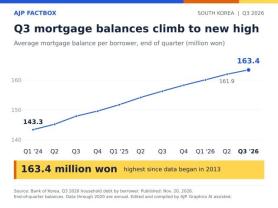
The average outstanding mortgage balance rose 1.47 million won from three months earlier to 163.4 million won ($123,000) at the end of September, the highest since the series began in 2013, according to the Bank of Korea (BOK) on Friday.
Borrowers in their 30s increased their share of new mortgage lending from 43.7 percent in the second quarter. Their average new mortgage grew by 7.76 million won, compared with a 6.47 million won increase for those in their 40s.
Across all age groups, the average new mortgage rose 6.22 million won to 214.51 million won.
The increase was concentrated in the greater Seoul area, where the average new mortgage climbed 13.23 million won. Gyeonggi Province and Incheon recorded a combined increase of 15.37 million won, while Seoul added 4.98 million won. The average new mortgage issued by banks rose 8.82 million won.
The BOK attributed the increase partly to a lag between home purchases and loan disbursements following a pickup in transactions in the capital region in the second quarter.
Although transactions slowed in the third quarter, rising home prices continued to push loan sizes higher. Move-ins at newly completed apartments also contributed, the central bank said.
The mortgage figures contrasted with a broader retreat in new household borrowing.
New household loans per borrower fell 3.86 million won to 30.28 million won, the lowest since the third quarter of 2022.
New unsecured loans per borrower dropped 3.28 million won to 16.42 million won, a series low. The average new household loan from non-bank lenders also fell to its lowest level since 2013, declining by 7.44 million won.
The BOK said a stock market correction had reduced demand for unsecured borrowing, while third-quarter bonus payments also helped curb borrowing needs.
Mortgage borrowing diverged by age. The average new mortgage fell 7.46 million won among borrowers in their 20s and 2.37 million won among those in their 50s.
The central bank linked those declines partly to weaker home sales outside the capital region and restrictions imposed since the second quarter on group loans and lending to non-members at non-bank institutions. Non-bank lenders’ share of new mortgage lending nearly halved to 7.3 percent from 14 percent.
Average outstanding household debt across all loan categories nevertheless edged up 80,000 won to 97.98 million won per borrower at the end of September.
The fourth-quarter outlook remains mixed, the BOK said. Housing transactions are slowing, but expectations of further price gains persist. Apartment move-ins are also expected to increase from the third quarter.
The government’s Aug. 13 measures expanded the amount available through group loans, potentially adding to upward pressure on mortgage sizes, it said.
The figures come ahead of the BOK’s Nov. 26 rate decision. Bank lending to households increased by 5 trillion won in October, accelerating from 500 billion won in September. Total household credit rose 9.8 trillion won in the third quarter to a record 2,030.5 trillion won.

Kim Yeon-jae
Kim Yeon-jae is a journalist at AJU Press (AJP's English platform),
covering macroeconomics, international finance, and geopolitics.
He closely tracks central bank monetary policies, global energy supply chains,
and the Korean defense industry.
Copyright ⓒ Aju Press All rights reserved.
Related News
-
 AJP Factbox: Q3 borrowers lean on home loans
Edited and compiled by AJP. Graphics AI asssisted. Edited and compiled by AJP. Graphics AI asssisted. Edited and compiled by AJP. Graphics AI asssisted.
-
 Korea's producer price softens Oct
SEOUL, November 20 (AJP) -- South Korea’s producer inflation eased in October as fresh food became cheaper and annual IT price growth slowed, while rising energy costs and imported raw material prices kept inflation pressure alive. The producer price index fell 0.1 percent from September, its first monthly decline since July, the Bank of Korea said Friday. Annual producer inflation eased to 7.2 percent from 7.6 percent. Fresh food prices plunged 14.5 percent from September, helping offset increases in industrial goods. IT prices rose 0.1 percent on the month, but their annual increase slowed to 8.8 percent from 11.0 percent. The easing was uneven: DRAM prices climbed 5.7 percent on the month and 327.8 percent from a year earlier. Producer prices excluding food and energy rose 0.1 percent on the month. Energy prices rose 0.8 percent from September and 12.6 percent from a year earlier, while imported raw material prices jumped 10.8 percent on the month. The broader domestic supply price index, which covers domestic shipments and imports, rose 0.7 percent from September and 8.2 percent on the year. The figures point to continued cost pressure in the production pipeline, with the extent to which higher input costs feed into finished goods and consumer prices a key development to watch. Tags: South Korea, producer prices, Bank of Korea, inflation, fresh food, IT prices, DRAM, energy prices, import costs
-
 Korea's fuel cap faces budget scrutiny
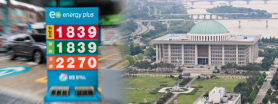
This combination photo shows fuel prices displayed at a gas station in Seoul on April 22, 2026 (left), and the National Assembly building in Yeouido, Seoul, on May 19, 2026. AJP Han Jun-gu. SEOUL, November 16 (AJP) — South Korea has allocated or proposed a combined 5.65 trillion won ($4.2 billion) across two fiscal years to cushion consumers against soaring fuel prices, drawing scrutiny over how the compensation bill is calculated and how further extensions would be funded. The government extended the cap for another four weeks on Friday, keeping maximum supply prices at 1,784 won per liter for gasoline, 1,773 won for diesel and 1,380 won for kerosene. The latest ceilings took effect Saturday, continuing a policy introduced in March to contain imported inflation. Dubai crude has retreated to around $90 a barrel from October’s higher levels but remains more than $20 above its late-June price. Shipping costs have also stayed elevated amid security risks around the Strait of Hormuz, according to the Ministry of Trade, Industry and Resources. The government has secured 4.2 trillion won in contingency funding to compensate refiners for losses incurred during the first three quarters of 2026. Another 1.45 trillion won has been proposed in the ministry’s 2027 budget, primarily to cover losses arising in the final quarter of this year. The combined figure represents available or proposed funding, not actual expenditure. It also excludes the potential cost of maintaining the controls throughout 2027. That distinction is central to questions raised by the National Assembly Budget Office (NABO), which challenged the reliability of the government’s compensation estimates in its October review of the proposed 2027 budget. Of the proposed 1.45 trillion won, 1.449 trillion won is intended for refiner compensation. The remainder would cover administrative expenses, including the settlement committee. The ministry told NABO that its estimate was based on simulations using, among other inputs, international oil price forecasts from the Korea Energy Economics Institute. The budget office said detailed simulation data had not been provided at the time of its review. The final bill could vary significantly depending on how long the cap remains in place, international crude prices, exchange rates, domestic sales volumes and the gap between regulated prices and recognized supply costs. Even the first settlement, covering March 13 through June 30, remained incomplete as of Oct. 6, according to the report. At a public briefing Friday, ministry officials said that settlement was nearing completion and that compensation calculated under the government’s cost-based rules should remain within the existing contingency allocation. The amount is expected to be disclosed by late November or early December. Payments could be completed this year, although objections from refiners could delay disbursement. The calculation method remains a point of contention between the government and the refining industry. The ministry says compensation should reflect actual costs and reasonable profits. Refiners have sought to use Singapore benchmark petroleum product prices, known as MOPS, to account for the opportunity cost of supplying fuel domestically rather than selling it abroad. The government has rejected that approach, arguing that compensation based on international market prices would undermine the purpose of the domestic cap. In an Oct. 17 explanation, the ministry said industry estimates of 7 trillion to 8 trillion won in accumulated losses reflected potential earnings rather than costs eligible for reimbursement. The eventual fiscal burden therefore cannot be calculated simply by comparing international product prices with the government’s ceilings. It will depend on the settlement committee’s assessment of refiners’ actual costs and eligible sales. Edited and compiled by AJP. Graphics AI assisted. An extension into 2027 would create a separate funding question. The proposed government budget includes 3.5 trillion won in earmarked contingency reserves for specified purposes, including responses to high oil prices and supply-chain disruptions. The Ministry of Planning and Budget has said the reserves were intended partly to prepare for fuel price controls continuing next year. The entire amount, however, is not dedicated to refiner compensation. NABO questioned whether contingency reserves should finance costs that become foreseeable when the government extends the cap. In its review of the overall 2027 budget, the office argued that reasonably predictable compensation should be funded through the regular budget, leaving contingency reserves for unexpected additional expenditure. Relying on reserves for foreseeable spending could limit lawmakers’ ability to examine the expected costs before approving the budget, it warned. NABO recommended that the ministry prepare spending scenarios based on different termination dates and revise its estimates once actual settlement figures become available. The lag between refiners incurring losses and receiving compensation further complicates fiscal planning. Losses from the final quarter of 2026 are expected to be settled next year because refiners must submit supporting documents after the accounting period ends. Compensation for any additional losses incurred under continued controls in 2027 would come on top of those obligations. The cap has nevertheless provided measurable relief from inflation. A Korea Development Institute (KDI) study released Thursday estimated that the policy lowered petroleum product price inflation by an average of about 12 percentage points between March and October. It reduced overall consumer price inflation by an estimated 0.6 percentage point on average. KDI also estimated that the recent oil price shock could shave about 0.4 percentage point off private consumption growth in 2026, although its model captured the mitigating effects of the cap only to a limited extent. Recent Bank of Korea data illustrate why falling crude prices alone offer little certainty about the compensation bill. Won-denominated import prices fell 1.8 percent in October from September as crude prices declined and the currency strengthened. Import prices for coal and petroleum products, however, rose 3.5 percent. Those movements do not establish refiners’ eligible compensation costs, but they underscore the limits of using crude prices alone to estimate the government’s liability. The first settlement, expected by early December, should give lawmakers a firmer basis for assessing the proposed 1.45 trillion won compensation budget. If the cap continues next year, the government will face a further test: how much of the additional bill it can reasonably anticipate — and how much should be submitted to parliamentary scrutiny through the regular budget.