

Kim Yeon-jae
Kim Yeon-jae is a journalist at AJU Press (AJP's English platform),
covering macroeconomics, international finance, and geopolitics.
He closely tracks central bank monetary policies, global energy supply chains,
and the Korean defense industry.
Copyright ⓒ Aju Press All rights reserved.
Related News
-
 Korea's 30s take up nearly half of new mortgage loan Q3
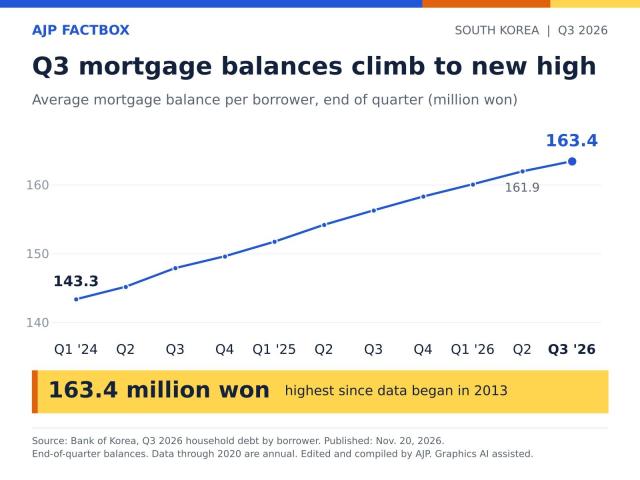
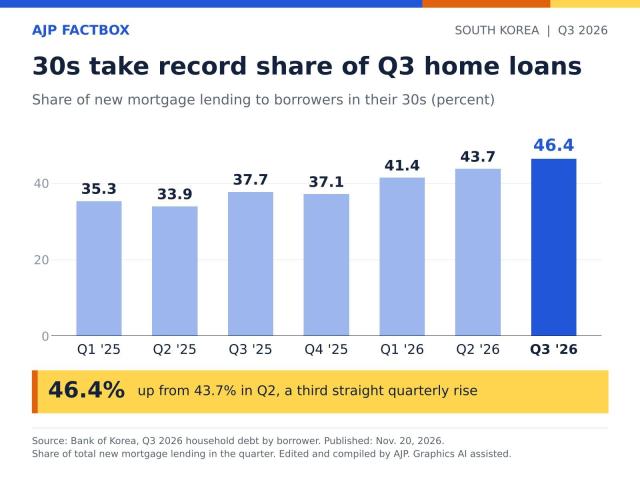
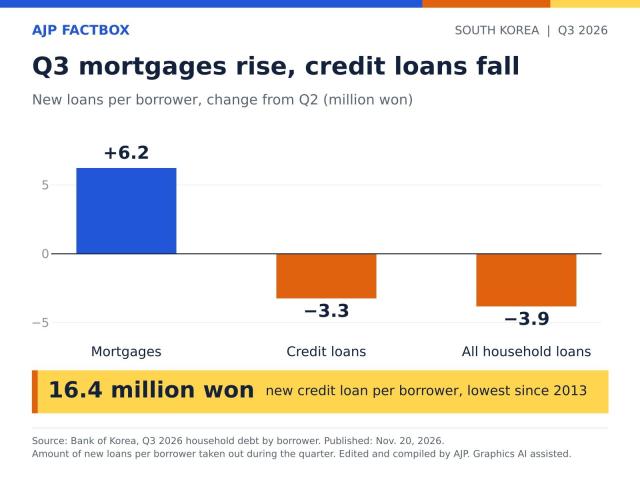
Apartment complexes in Songpa District, southeastern Seoul, are seen from the observatory of Lotte World Tower on Aug. 11, 2026. AJP Yoo Na-hyun SEOUL, November 20 (AJP) —South Koreans in their 30s accounted for a record 46.4 percent of new mortgage lending in the third quarter as rising home prices helped push average mortgage debt per borrower to an all-time high. The average outstanding mortgage balance rose 1.47 million won from three months earlier to 163.4 million won ($123,000) at the end of September, the highest since the series began in 2013, according to the Bank of Korea (BOK) on Friday. Borrowers in their 30s increased their share of new mortgage lending from 43.7 percent in the second quarter. Their average new mortgage grew by 7.76 million won, compared with a 6.47 million won increase for those in their 40s. Across all age groups, the average new mortgage rose 6.22 million won to 214.51 million won. The increase was concentrated in the greater Seoul area, where the average new mortgage climbed 13.23 million won. Gyeonggi Province and Incheon recorded a combined increase of 15.37 million won, while Seoul added 4.98 million won. The average new mortgage issued by banks rose 8.82 million won. The BOK attributed the increase partly to a lag between home purchases and loan disbursements following a pickup in transactions in the capital region in the second quarter. Although transactions slowed in the third quarter, rising home prices continued to push loan sizes higher. Move-ins at newly completed apartments also contributed, the central bank said. The mortgage figures contrasted with a broader retreat in new household borrowing. New household loans per borrower fell 3.86 million won to 30.28 million won, the lowest since the third quarter of 2022. New unsecured loans per borrower dropped 3.28 million won to 16.42 million won, a series low. The average new household loan from non-bank lenders also fell to its lowest level since 2013, declining by 7.44 million won. The BOK said a stock market correction had reduced demand for unsecured borrowing, while third-quarter bonus payments also helped curb borrowing needs. Mortgage borrowing diverged by age. The average new mortgage fell 7.46 million won among borrowers in their 20s and 2.37 million won among those in their 50s. The central bank linked those declines partly to weaker home sales outside the capital region and restrictions imposed since the second quarter on group loans and lending to non-members at non-bank institutions. Non-bank lenders’ share of new mortgage lending nearly halved to 7.3 percent from 14 percent. Average outstanding household debt across all loan categories nevertheless edged up 80,000 won to 97.98 million won per borrower at the end of September. The fourth-quarter outlook remains mixed, the BOK said. Housing transactions are slowing, but expectations of further price gains persist. Apartment move-ins are also expected to increase from the third quarter. The government’s Aug. 13 measures expanded the amount available through group loans, potentially adding to upward pressure on mortgage sizes, it said. The figures come ahead of the BOK’s Nov. 26 rate decision. Bank lending to households increased by 5 trillion won in October, accelerating from 500 billion won in September. Total household credit rose 9.8 trillion won in the third quarter to a record 2,030.5 trillion won.
-
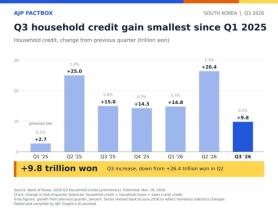 AJP Factbox: Q3 household credit gain smallest since Q1 2025
Edited and compiled by AJP. Graphics AI assisted. Edited and compiled by AJP, Graphics AI assisted.
-
 Korea's household debt grows by slowest in six quaters
A screen shows major stocks trading lower at Woori Bank’s dealing room in Seoul on September 14, 2026 (left), while apartment complexes are seen from the observatory of Lotte World Tower in Songpa District, Seoul, on August 11, 2026. AJP Yoo Na-hyun SEOUL, November 18 (AJP) — South Korea’s household debt rose by the slowest in six quarters between July and September as asset frenzy fizzled out amid higher interest rates, central bank data showed Wednesday. Household credit, which covers household loans and unpaid card purchases, rose 9.8 trillion won ($7.3 billion) from the previous quarter to 2,030.5 trillion won at the end of September, according to preliminary Bank of Korea (BOK) data. The increase slowed sharply from a revised 26.4 trillion won in the second quarter, which had initially been reported at 25.9 trillion won. Household loans grew 4.7 trillion won to 1,896.8 trillion won, the smallest increase since the first quarter of 2025. Other loans, including credit loans and margin lending by brokerages, fell 4.9 trillion won, their first decline in four quarters. Credit extended by securities firms to households shrank 3.1 trillion won, after rising 4.2 trillion won in the second quarter. “Other loans increased in the second quarter because the stock market was strong, and much of the decline in the third quarter came from the market correction,” Kim Sung-jun, head of the BOK’s financial statistics team, said at a briefing. Kim Sung-jun, head of the Bank of Korea’s financial statistics team, answers questions at a briefing on third-quarter household credit at the BOK in Seoul, November 18, 2026. Bank of Korea Kim had said in August that the market correction that began in the third quarter would likely slow securities-related borrowing. Higher policy and market rates have pushed up mortgage rates, Kim said, but most of the slowdown came from other loans. Housing-related loans rose 9.6 trillion won to a record 1,202.3 trillion won, slowing from 12.2 trillion won as home transactions declined. Group loans for new apartment projects drove the slowdown, while individual mortgages barely slowed, Kim said. Bank housing loans accelerated to 9.0 trillion won from 6.8 trillion won, while those at non-bank deposit-taking lenders slowed to 0.8 trillion won. Sales credit, mostly unpaid card purchases, jumped 5.0 trillion won to 133.7 trillion won, the second-largest quarterly gain on record. Kim linked the rise to long-term installment offers, appliance cashback promotions and stronger smartphone sales rather than seasonal factors, noting that private consumption fell in the quarter. Household credit has grown 51 trillion won so far this year, nearing last year’s full-year increase of 56.9 trillion won. Government lending curbs and fewer home transactions are likely to restrain borrowing in the fourth quarter, Kim said, though more apartment move-ins, expectations of higher home prices and stock market swings could change that. Household loans across the financial sector rose 6.4 trillion won in October, according to financial regulators. Kim said the household debt-to-GDP ratio likely fell in the third quarter as nominal growth outpaced borrowing, bringing it close to slipping below 80 percent. The slowdown in consumer loan is likely lighten the tightening burden for the Bank of Korea which meets for this year's last rate-setting meeting on Nov. 26. After holding the base rate at 3.00 percent in October following hikes in July and August, the BOK said it would decide the timing and pace of further increases, and Governor Shin Hyun-song said the current tight stance needed to continue.