
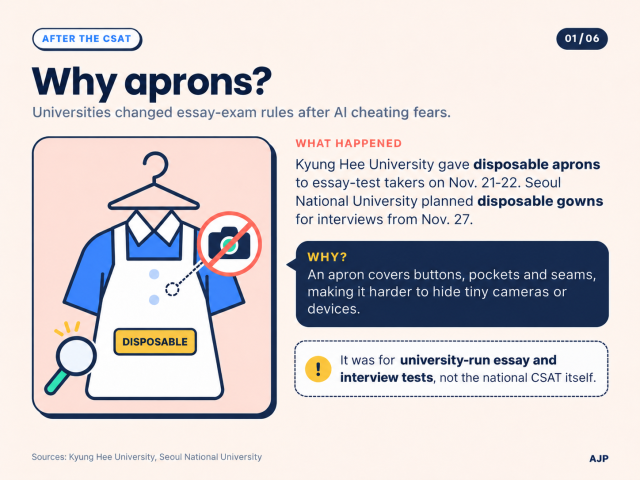
Q1. Why were students wearing aprons?
Students taking essay examinations at Kyung Hee University on November 21 and 22 were required to wear disposable aprons as part of measures to prevent AI-assisted cheating. The aprons covered their clothing, making it more difficult to use miniature cameras or electronic devices concealed in buttons and other accessories. The unusual measure was introduced for university-administered examinations following the national CSAT, rather than the CSAT itself.
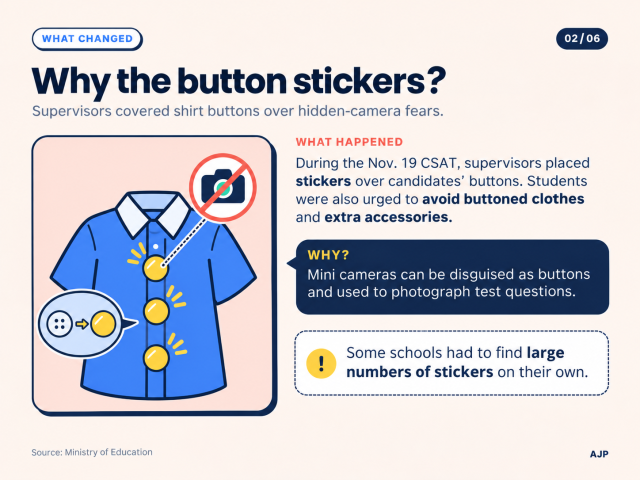
Q2. Why were stickers placed on clothing buttons?
During the November 19 CSAT, exam supervisors introduced stickers to cover clothing buttons amid concerns that miniature cameras could be disguised as ordinary accessories. The measure reflected growing fears that increasingly sophisticated cheating devices could be hidden in everyday objects. Students were also encouraged to avoid clothing and accessories that might raise suspicion during inspections.
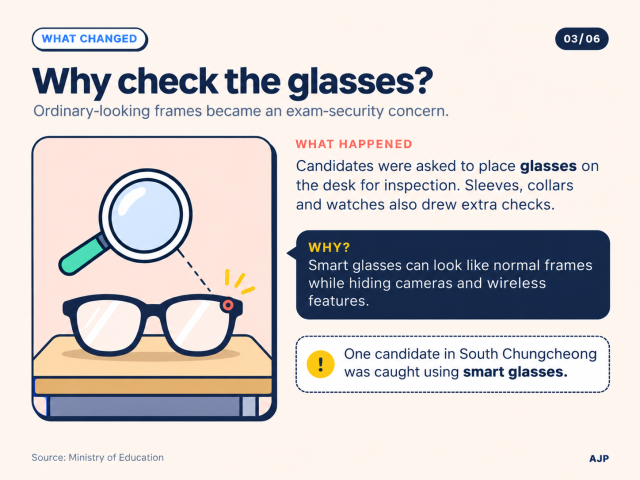
Q3. Why were students' glasses being inspected?
Smart glasses equipped with cameras and wireless communication technology emerged as a potential cheating risk. Exam supervisors conducted additional checks of eyewear to identify suspicious devices. Some students reportedly chose to wear contact lenses instead of glasses to avoid extra scrutiny. What had previously been an ordinary personal accessory became another item subject to examination security checks.
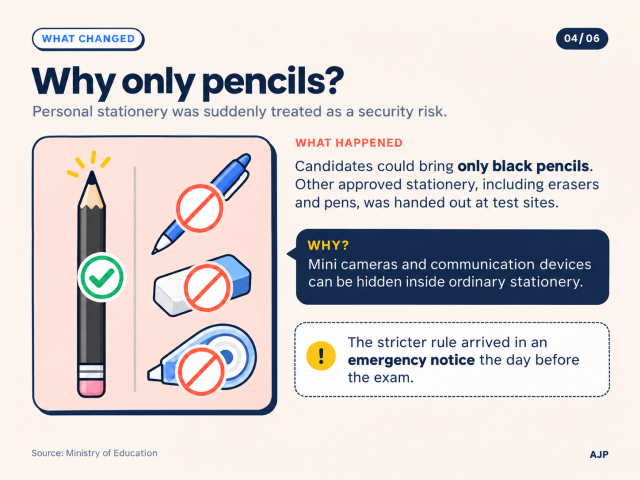
Q4. Why couldn't students use their own pens and erasers?
Authorities strengthened restrictions on personal stationery over concerns that electronic components could be concealed inside writing instruments. Students were generally permitted to bring black pencils, while other approved stationery was provided at examination centers. Some universities also introduced stricter rules for their own entrance examinations, with last-minute announcements causing confusion among applicants.
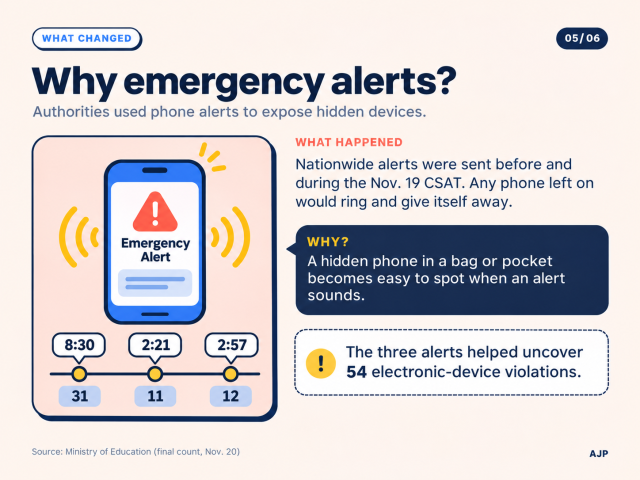
Q5. Why were emergency alerts sent during the exam?
The government issued nationwide emergency alerts during the CSAT to help expose mobile phones that had not been surrendered before the examination. The alerts were intended to make concealed devices detectable to supervisors. According to the Education Ministry, 54 electronic-device violations were discovered through the alerts, highlighting how authorities were adopting unusual methods to combat potential technology-assisted cheating.

Q6. Were 111 students caught cheating with AI?
No. The Education Ministry reported 111 electronic-device-related violations during the 2027 CSAT, but these were not all cases of AI-assisted cheating. The figure included 54 cases detected through emergency alerts, 52 through other inspections and five involving the use of smart devices during the examination. Most violations concerned prohibited electronic devices, making it important to distinguish possession from the use of technology to obtain unauthorized assistance.
Joonha Yoo is a bilingual journalist at AJU Press (AJP), covering music, culture, entertainment and Korea’s automotive industry.
Raised in Fort Collins, Colorado, he often writes from the scene, bringing firsthand detail to stories ranging
from BTS comeback concerts to unique cultural events that catch the world's eye.
Copyright ⓒ Aju Press All rights reserved.
Related News
-
 Easier CSAT raises the bar for Korea's top universities
SEOUL, November 20 (AJP) - South Korea's top universities are expected to see higher admission score cutoffs after an easier national college entrance exam, with leading medical schools projected to require nearly perfect scores. Jongro Academy, a major private education institute, estimated Friday that Seoul National University's medical school would require 298 out of 300 points, up four from last year. The forecast was based on preliminary results from Thursday's College Scholastic Ability Test (CSAT), South Korea's national university entrance exam. At Seoul National, Yonsei and Korea universities, widely regarded as the country's three most prestigious institutions, business program cutoffs were estimated at 287, 283 and 283 points, respectively. Semiconductor engineering programs at Yonsei and Korea universities were expected to require 281 points, up 10 and 12 points, respectively. The estimates apply to regular admissions, which rely heavily on CSAT scores, and remain preliminary pending official exam results. Tags: South Korea CSAT, 2027 College Entrance Exam, Seoul National University, Medical School Admissions, University Admission Scores
-
College Entrance Exams Begin Following the CSAT; 14 Universities Start Essays and Interviews This Weekend
The 2027 College Scholastic Ability Test (CSAT) has concluded, and the schedule for university-specific entrance exams (essays and interviews) is set to begin immediately. Starting this weekend (November 21-22), 14 universities, including Korea University, Sogang University, Sungkyunkwan University, and Kyung Hee University, will conduct essay exams, followed by a flurry of interviews for comprehensive student evaluations that will continue into early December. On November 20, the admissions information platform JinHakSa reported that 44 universities conducting essay evaluations have concentrated their schedules over the next two weekends (November 21-22 and November 28-29), with 14 universities holding exams during this period. This weekend, on the 21st, the following universities will conduct essay exams: Konkuk University, Kyung Hee University (some humanities and medicine), Korea University (natural sciences), Sogang University (natural sciences), Sungkyunkwan University (language type), Sookmyung Women’s University (some humanities and natural sciences), Soongsil University, Seoul Women’s University, Suwon University (natural sciences), and Korea Aerospace University. On the 22nd, the following universities will continue: Catholic University (medicine), Kyung Hee University (some humanities and natural sciences), Korea University (humanities), Dongguk University, Sogang University (humanities), Sungkyunkwan University (mathematics type), Sookmyung Women’s University (some humanities), Suwon University (humanities), Korea University of Technology and Education, and Hongik University (Sejong). Among these, Sogang University (123.65 to 1) and Sungkyunkwan University (102.37 to 1) recorded high competition ratios exceeding 100 to 1 this year. Next weekend, on November 28-29, Hanyang University (134.47 to 1), which recorded the highest overall competition ratio among the 44 universities, will hold its essay exam, along with Chung-Ang University (general type), Ewha Womans University, Hankuk University of Foreign Studies, Kyungpook National University, Pusan National University, Sejong University, Kwangwoon University, and Gachon University. Following that, on December 5-6, the second highest overall competition ratio, Kookmin University (131.63 to 1), along with Ajou University, Inha University, and Hanshin University, will complete the final essay schedule. This year, the average competition ratio for essay evaluations was around 48 to 1, with a significant influx of applicants in the medical and pharmacy fields. Kyung Hee University’s Korean Medicine program (humanities) saw 3,111 applicants for 5 spots, resulting in a record competition ratio of 622.20 to 1. Other notable programs included Samyook University’s pharmacy program (563.40 to 1), Ajou University’s pharmacy program (527.00 to 1), and Sungkyunkwan University’s medical program (524.60 to 1), all exceeding 500 to 1. However, experts in the admissions industry agree that there is no need to be intimidated by the apparent high competition ratios. The essay evaluations often see high absentee rates as students may decide to forgo the exam if they believe they are better suited for regular admissions based on preliminary CSAT scores or if they do not meet the minimum CSAT requirements. Consequently, the actual competition ratios drop significantly. In fact, an analysis of the 2026 essay evaluation results released by Kyung Hee University, Korea University, Dongguk University, and Sogang University revealed that only 23 to 35% of initial applicants actually took the essay exam and met the minimum CSAT requirements. For Korea University, the initial competition ratio was 71.8 to 1, but the actual competition ratio, considering those who took the exam and met the minimum CSAT requirements, plummeted to 16.8 to 1. Excluding those who failed the essay, the ratio fell below 13.0 to 1, dropping to one-fifth of the initial competition ratio. Similarly, Kyung Hee University (66.6 to 1 to 19.4 to 1), Dongguk University (54.4 to 1 to 16.0 to 1), and Sogang University (107.1 to 1 to 37.2 to 1) also saw their actual competition ratios reduced to about one-third of their initial ratios. Alongside the essays, the interview schedules for comprehensive evaluations at major universities are also ramping up. On the 21st, Yonsei University’s outstanding activity type (humanities/integrated) and Ewha Womans University’s future talent type (humanities) will kick off, followed by Seoul City University (natural sciences) and Yonsei University’s international type on the 29th, and on December 6, Kyung Hee University’s Neo-Renaissance, Sungkyunkwan University’s Sungkyun Talent, and Chung-Ang University’s inquiry type talent interviews will continue every weekend. CSAT score reports will be issued on December 11, and the first round of early admission results will be finalized by December 18. Following that, early registration will take place from December 21-23, with supplementary admissions from December 24-29, and regular admissions applications will be conducted by each university from January 4-7 next year. JinHakSa’s admissions strategy research director Woo Hyun-cheol advised, “Students should quickly assess their chances for regular admissions based on their preliminary CSAT scores and decide whether to take the essay exam. Especially if they are near the expected cutoff and are uncertain about meeting the minimum CSAT requirements, it would be advantageous to actively participate in the essay exam, considering the possibility that the final cutoff may differ from expectations.”* This article has been translated by AI.
-
 Heartfelt scenes at 2027 CSAT in Yeouido, Seoul
AJP Yoo Na-hyun A student hugs her mother after completing the 2027 College Scholastic Ability Test (CSAT), South Korea's annual college entrance exam, at Yeouido Girls' High School in Yeongdeungpo District, Seoul, on the afternoon of November 19, 2026.