
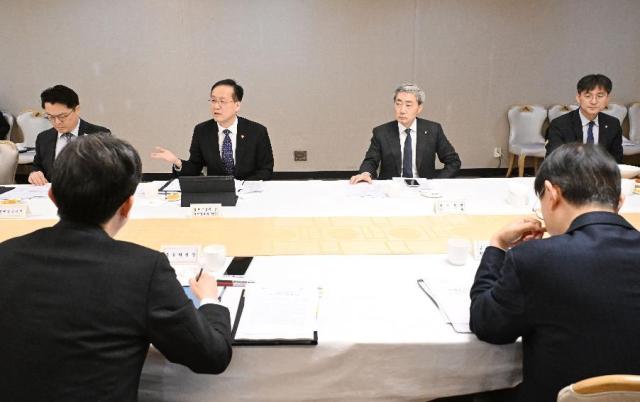
The meeting came a day after the BOK's third rate hike lifted the benchmark to a two-year high of 3.25 percent and signaled further increases in 2027 as it raised its growth forecast for next year to 4.1 percent on the strength of the chip boom.
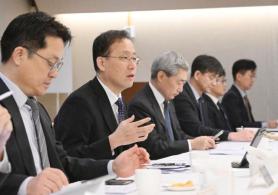
Finance Minister Lee Hyoung-il, BOK Governor Shin Hyun-song and the two regulatory chiefs agreed that the growing links between the chip cycle and financial markets warranted closer scrutiny of how risks spread through the economy.
But the meeting produced no move to deploy a stock stabilization fund of 10 trillion won ($7.45 billion) or more, or the other options Lee has said he has at hand.
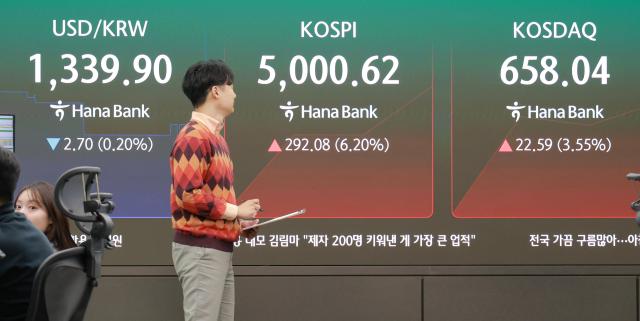
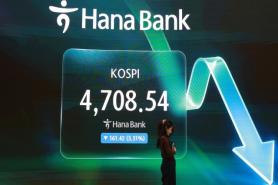
A sharp stock rebound gave authorities room to hold their fire. The KOSPI rose more than 4 percent and the smaller KOSDAQ more than 8 percent as foreign investors returned in force.
Foreigners bought a net 1.1 trillion won on the KOSPI, while combined foreign and institutional net buying on the KOSDAQ approached 1 trillion won amid expectations of support measures to draw institutional money into the market.
Authorities are conserving their ammunition for a potentially bumpy road as monetary tightening gathers pace globally.
Accounts of the European Central Bank's October meeting, released Thursday, showed that "a large number of members" could have supported a hike. Policymakers have since signaled a 25-basis-point increase on Dec. 17.
The Bank of England raised its rate to 4 percent on Nov. 5, its first increase in more than three years, while most economists expect the Bank of Japan to lift its 1.25 percent rate next month.
The European and British moves are driven largely by energy prices tied to the Middle East conflict. The BOK, by contrast, is responding to demand pressure from the chip boom.
That leaves Korea exposed to a particular risk: higher global borrowing costs could weaken the increasingly debt-funded AI spending that is powering its growth.
Big technology companies have historically continued to increase investment even as U.S. bond yields rose, the BOK said in a report released alongside its rate decision.
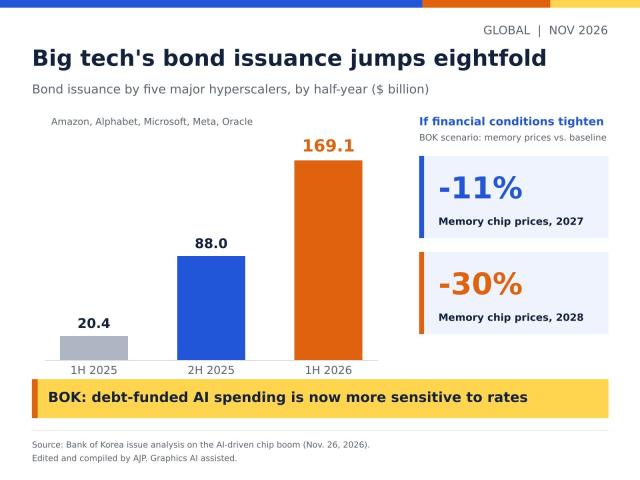
But their reliance on borrowing has grown sharply. Bond issuance by five major hyperscalers — technology companies operating vast cloud and AI infrastructure — jumped more than eightfold to $169.1 billion in the first half of this year from $20.4 billion a year earlier, the report said.
Their capital spending is expected to exceed operating cash flow, leaving investment more sensitive to financing conditions.
Under a scenario of tighter financial conditions, the BOK estimated that memory chip prices would fall 11 percent below its baseline next year and 30 percent below it in 2028.
If that shock coincided with delayed AI investment and expanded Chinese memory output, Korea's growth could slow to 2.1 percent in 2028, well below the bank's 3 percent baseline.
The effects of this year's rate hikes will begin to show from the second quarter of 2027 and far outweigh the boost to growth from chip-sector bonuses, Kang Seung-won, an analyst at NH Investment & Securities, wrote.
The trickle-down from technology investment may also be "structurally smaller than policymakers expect," Kang wrote, noting that U.S. wage growth continued to slow despite years of heavy AI spending.
Shin has argued that monetary policy must weigh the economy as a whole, saying Thursday that "if you look at only one sector, you can misstep."
Yet the sector underpinning his stronger growth forecast is also acutely exposed to financing and investment decisions beyond the BOK's reach.
Global tightening could, in turn, limit the central bank's room to reverse course if growth falters.
Thursday's hike narrowed the gap between Korea's benchmark rate and the upper bound of the Fed's range to 0.75 percentage point. A quarter-point Fed hike in December would widen it back to 1 percentage point.
Korean government bond yields continued to rise Friday. The three-year yield climbed 6.3 basis points to 3.685 percent, while the 10-year yield rose 4.2 basis points to 3.832 percent.
The BOK acknowledged that the risks run both ways. With AI demand still in its early stages, the chip upturn could also last longer than expected, it said in the report.
For now, the next tests come in quick succession: the Fed meets Dec. 9, followed by the ECB and Bank of England on Dec. 17 and the Bank of Japan on Dec. 18.
Kim Yeon-jae
Kim Yeon-jae is a journalist at AJU Press (AJP's English platform),
covering macroeconomics, international finance, and geopolitics.
He closely tracks central bank monetary policies, global energy supply chains,
and the Korean defense industry.
Copyright ⓒ Aju Press All rights reserved.
Related News
-
 Seoul watches markets, silent on rescue fund
Deputy Prime Minister and Finance Minister Lee Hyung-il speaks during a market situation meeting at the Government Complex Seoul on November 27, 2026. Courtesy of the Ministry of Finance and Economy SEOUL, November 27 (AJP) —South Korea pledged closer scrutiny of risks spilling from the chip boom into financial markets Friday but gave no update on deploying a stock market stabilization fund, as officials found no unusual short-selling activity despite retail investors’ calls for a temporary ban. Stock market volatility has increased amid uncertainty over the global AI industry and shifting trade conditions, the Ministry of Finance and Economy said after a meeting of top economic and financial officials. Officials agreed to closely monitor how risks spread between the real economy and financial markets as their links to the chip cycle deepen. The meeting was chaired by Deputy Prime Minister and Finance Minister Lee Hyoung-il and attended by Bank of Korea Governor Shin Hyun-song, Financial Services Commission Chairman Lee Eog-weon and Financial Supervisory Service Governor Lee Chan-jin. The government began preparing to deploy a stock market stabilization fund and eased daily share buyback limits for three months under its Nov. 22 stabilization package. The measures followed a 5.21 percent plunge in the KOSPI on Nov. 20. Friday’s statement offered no further details on the fund’s activation. Officials said they remained ready to take additional steps depending on market conditions. A temporary short-selling ban, sought by retail investors, was also absent from the Nov. 22 package. Officials reviewed short-selling trading value, outstanding balances and the number of stocks flagged for overheated short selling but found no unusual trends. A joint task force on illegal short selling launched Nov. 24 will monitor daily trading and respond firmly to violations, the ministry said. The meeting came a day after the BOK warned that big tech’s growing reliance on bond markets to finance AI investment has made the chip boom more sensitive to financing conditions. Bond issuance by five major hyperscalers — technology companies operating vast cloud and data-center networks — surged to $169.1 billion in the first half of this year from $20.4 billion a year earlier, according to the central bank’s report. Officials said currency and bond markets had remained broadly stable as oil prices fell. Housing prices in Seoul were also showing clearer signs of stabilizing.
-
 OPINION: Crying wolf squanders Seoul's market firepower
KOSPI zooms back to January levels in November, giving up all of its staggering gains in the first half in the second half. AJP Ha Sung-min on Hana Bank dealing room on Nov. 23 Teasing can be tantalizing—up to a point. Beyond that, it becomes simply annoying. Seoul has been teasing investors with a rescue fund and fidgeting over its deployment as its stock market sinks among the worst performers of the second half, despite being home to two of the world’s chip behemoths, Samsung Electronics and SK hynix. Officials are checking contributions, weighing the appropriate size and considering when to intervene. Each announcement is intended to convey resolve. With repetition, however, it increasingly reveals reluctance. A government can exhaust the persuasive power of a rescue fund before spending a single won. “In the short run, the market is a voting machine but in the long run it is a weighing machine,” Warren Buffett wrote in his 1987 shareholder letter, quoting his mentor Benjamin Graham. Korean companies still carry considerable earnings weight. Investors, meanwhile, are voting with their feet. Bank of Korea Governor Shin Hyun-song expressed his bewilderment at semiconductor valuations after Thursday’s rate-setting meeting. “The combined market capitalization of semiconductor stocks is just over 2,000 trillion won ($1.5 trillion). That it amounts to only three times this year’s earnings (of 700 trillion won) is difficult to explain logically,” Shin said. Investors have reasons to look beyond this year’s profits. Memory earnings are cyclical, and doubts about AI financing, returns and future investment deserve attention. Exceptional profits can make stocks look deceptively cheap before the cycle turns. Yet the central bank’s outlook hardly suggests an economy running out of strength. It projects growth of 3.9 percent this year and 4.1 percent next year. Even its combined downside scenario—delayed AI investment, tighter financing and increased Chinese memory supply—leaves next year’s growth in the mid-3 percent range. The distance between that assessment and the anxiety consuming the stock market has become difficult to ignore. Through Nov. 26, the KOSPI had fallen 17.79 percent from its October close, compared with declines of 13.40 percent in Taiwan, 9.15 percent in Japan and 3.39 percent in Shanghai, according to Financial Supervisory Service data. Seoul and Taipei are particularly exposed to the shifting mood around AI. Their chip-heavy markets rise on confidence in the next wave of data center spending and recoil at doubts over its financing and returns. The Jensen Huang debacle added another source of turmoil, leaving investors trading on the fortunes of Nvidia’s chief executive as well as the prospects of their own semiconductor companies. Both markets had substantial gains to surrender. The KOSPI remained 11.79 percent above its year-end level, while Taiwan’s TAIEX was still up 35.18 percent. But their shared vulnerability makes the divergence in official responses all the more striking. Taiwan has committed money. Seoul continues to discuss its availability. Taipei authorized its National Financial Stabilization Fund to intervene on Nov. 6 and subsequently confirmed that purchases had begun. The NT$500 billion funding ceiling represents capacity rather than money already spent, but investors know there is an actual buyer behind the announcement. Taiwan has also prohibited short sales below the previous session’s closing price, with exemptions for certain hedging transactions, and raised the minimum margin requirement for margin short sales to 150 percent from 130 percent. These restrictions stop short of an outright ban. They nonetheless make the authorities’ determination to temper the selling pressure unmistakable. Korea need not reproduce the package. It already operates an uptick rule, and further restrictions could complicate trading just as Seoul is trying to establish a more predictable market for international investors. But caution over short selling does not explain why the rescue fund must remain indefinitely in reserve. Korea’s hesitation is compounded by the modest size of its proposed defense. The stabilization fund carries commitments of 10.76 trillion won, or about $8 billion—roughly half Taiwan’s NT$500 billion, or approximately $15 billion, capacity. Neither figure represents money already spent. The difference is that Taipei has begun buying, while Seoul is still checking whether contributors can deliver their pledges. Korea’s financial firepower has also failed to keep pace with its market. The first stabilization fund, established in 1990, amounted to 4.86 trillion won, equivalent to 5.6 percent of KOSPI market capitalization. Today’s commitment is more than twice as large in nominal terms but covers only about 0.3 percent of the market. That disparity has prompted calls for a substantial increase. Mirae Asset Group Chairman Park Hyeon-joo has proposed expanding the fund to 100 trillion won. Authorities are examining additional contributions, although the size, timing and terms of any deployment remain unsettled. There are sound reasons to preserve some capacity. Lee Hyo-seob, a senior researcher at the Korea Capital Market Institute, warned that rapid spending could expose the fund’s remaining resources and make its purchases predictable. Previous interventions also offer no clear evidence that official buying alone produced a sustained recovery. But preserving resources and preserving confidence are increasingly competing considerations. The funds prepared in 2020 and reconsidered in 2022 were never deployed. Those precedents may encourage officials to believe that reassurance will again suffice. They may equally encourage investors to assume that another announcement will lead nowhere. A larger commitment would strengthen Seoul’s hand. A measured deployment would establish that it intends to use it. The fund would not have to match that outflow to influence sentiment. A credible buyer can encourage others to reconsider whether the retreat has gone too far. Its purchases would give substance to the government’s assessment that corporate fundamentals remain sound. An old funding pledge, repeatedly dusted off, offers less reassurance. Korea Development Bank has been checking whether participating institutions can honor their commitments and provide additional contributions. Because the money is called when needed, those arrangements matter. They should now produce an executable decision and a measured opening round of purchases. The reservations are serious. Participating institutions could lose money. Broad index purchases would channel considerable support toward the semiconductor giants whose fortunes already dominate the market. Selecting individual companies would invite disputes over fairness. Withdrawal could become difficult once investors grow accustomed to official support. Clear investment principles, limits on exposure and an exit framework would help contain those risks. None becomes easier to resolve through another week of hesitation. There is also concern that domestic institutions would end up buying shares from departing foreigners. That possibility is inherent in any intervention during an overseas sell-off. The relevant question is whether the purchases restore more orderly trading at a reasonable cost. Inaction carries its own costs. Falling collateral values can trigger margin calls, forcing investors to sell into an already retreating market. Household losses weigh on spending. Depressed valuations make fresh equity more expensive. A reassessment of future earnings can become a liquidation driven by immediate financial necessity. For now, Korea has room to respond before the strain spreads further. Between end-October and Nov. 26, the dollar rose only 0.63 percent against the won. Korea’s sovereign credit-default-swap premium stood at 23.7 basis points, slightly below October’s 24.1. The yield gap between three-year AA-minus corporate bonds and government bonds narrowed to about 67 basis points from 69. These indicators suggest that the equity rout has been accompanied by comparatively steady currency and credit conditions. That gives policymakers breathing room—and a chance to contain the damage before several markets require attention at once. Taiwan’s intervention offers no guarantee of recovery. Its benchmark remained about 1.4 percent below its Nov. 6 authorization-day close on Thursday. Its smaller monthly decline cannot be attributed solely to official purchases, nor can anyone establish how far it would have fallen without them. Still, Taipei has accepted that restoring confidence requires taking some risk. A stabilization fund cannot manufacture AI profits or prevent the next memory downturn. It can ease indiscriminate selling and give investors time to distinguish weakening prospects from prices depressed by fear. Seoul has already described the volatility as exceptional. Its central bank governor has questioned the logic of chip valuations. Financial officials insist that the resources are available. The longer those declarations go unanswered by action, the more expensive it may become to make them credible. Investors have heard enough about what the government stands ready to do. The next announcement should tell them what it has done. *The author is the managing editor of AJP. **The views expressed are the author's own.
-
 BOK sees economy running hot, households remain cold
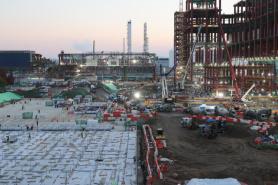
Samsung Electronics P5 next-gen fab under construction in Pyeongtaek, Gyeonggi Province. AJP Han Jun-gu SEOUL, November 26 (AJP) - South Korea's chip-powered boom will sustain growth near 4 percent this year and next, the central bank projected Thursday, tilting policy toward further tightening. But its sanguine outlook sits uneasily with real household income and self-employed earnings posting their first declines in nearly three years. The Bank of Korea (BOK) raised its policy rate to 3.25 percent from 3.00 percent at its final policy meeting of the year, delivering its third hike alongside growth forecasts of 3.9 percent for 2026 and 4.1 percent for 2027. Next year's estimate was lifted sharply from 2.9 percent in August. The unusually upbeat message from the typically cautious bank challenged expectations of slower growth and a winding-down of the tightening cycle. Governor Shin Hyun-song's argument was simple: staggering semiconductor profits would spread through corporate taxes, performance bonuses, dividends and investment, putting the expansion on a broader footing. "The 700 trillion won ($521.3 billion) in operating profit does not disappear into a black hole. It flows into corporate taxes and performance bonuses," he said, referring to the estimated operating income of Samsung Electronics and SK hynix for 2026. The figure is equivalent to roughly a fifth of national income, he said, estimating nominal gross domestic product swell well above 3,000 trillion won this year from about 2,600 trillion won last year. "There are substantial grounds for next year's 4.1 percent forecast." Bank of Korea Governor Shin Hyun-song speaks during a press conference after the Monetary Policy Board meeting in Seoul on November 26, 2026. Courtesy of the Bank of Korea The BOK raised its core inflation forecast to 2.6 percent for both this year and next, citing the pass-through of high oil prices and demand-side pressures it expects to "gradually build." Shin said a BOK analysis due Dec. 15 shows cost pressures still dominate price gains, but demand is also clearly supporting inflation. Asked why inflation forecasts rose only modestly despite the growth upgrade, Shin said: "It is because we assume monetary policy will be used appropriately." That answer makes further tightening part of the bank's outlook. Inflation is expected to return to its 2 percent target only in 2028. Board members' six-month rate projections had a median of 3.50 percent, with seven of the 21 dots at 3.75 percent and none below the newly raised policy rate. Bond markets took the hint. The three-year Korean government bond yield rose 3.9 basis points to 3.622 percent, while the 10-year yield climbed 2.9 basis points to 3.790 percent. The household scorecard told a different story. Inflation-adjusted household income fell 2.1 percent from a year earlier in the third quarter, its first decline in 10 quarters and the steepest since the second quarter of 2023, according to data released Thursday by the Ministry of Data and Statistics. Average monthly income rose just 0.8 percent in nominal terms to 5.48 million won, well below inflation of 2.9 percent. A shopper hands over a 10,000-won bill at a vegetable stall in Gyeongdong Market in Seoul on August 13, 2026. AJP Han Jun-gu Business income, which captures earnings from self-employment, fell 1.4 percent to a monthly average of 975,000 won per household, its first contraction in 12 quarters. Property income, including interest and dividends, dropped 11.1 percent, while transfer income fell 8.5 percent. Public transfers declined sharply from a year earlier, when nationwide consumption vouchers had boosted government support. For mom-and-pop stores, the squeeze is already cutting into sales and margins. Average sales per store fell 4.36 percent from a year earlier in the third quarter, the first decline in five quarters, according to small-business data provider Korea Credit Data. Average profit dropped 8.30 percent. Overdue loans owed by individual business owners jumped 21.5 percent to 16.4 trillion won. The BOK said in September that the delinquency rate on self-employed loans stood at 1.99 percent at the end of June, above the long-term average of 1.60 percent. The poorest households had the least cushion. Income among the bottom 20 percent fell 2.7 percent, making them the only income group to post a nominal decline. More than half — 56.6 percent — spent more than their disposable income. The BOK's own forecasts acknowledge that stronger consumption will take time. The bank cut this year's private consumption growth forecast to 1.8 percent from 2.1 percent, with Shin citing the stock market slump, which he said has tightened financial conditions. Consumption growth is projected to slow to 1.1 percent in the second half of this year and reach only 1.6 percent in the first half of 2027 before accelerating to 3.1 percent in the second half. For next year as a whole, the bank expects consumption growth of 2.4 percent. Edited and compiled by AJP. Graphics AI assisted. Shin attributed the lag to where the windfall is landing. National income has tilted to roughly 60 percent for corporate profits and 40 percent for wages this year, compared with a historically even split, he said. Much of the money is sitting in short-term markets, awaiting investment or dividend payments next year or the year after. Corporate taxes will reach households through next year's budget. "It is only a matter of time." But the channels carrying that money to households are uneven. The BOK expects wage gains to be concentrated in IT-sector bonuses, with increases in non-IT industries such as construction remaining limited. Part of the dividend windfall will also flow to foreign shareholders. Markets still need to see the projected growth materialize, Yoon Yeo-sam, a fixed-income analyst at Meritz Securities, told AJP. Shin offered no detailed explanation of how tighter financial conditions from falling stocks and uncertainty over the chip industry would play out, Yoon said. Shin argued that monetary policy must consider the economy as a whole. "If you look at only one sector, you can misstep," he said. That leaves vulnerable borrowers relying on fiscal support and debt restructuring, which Shin said are better suited than monetary policy to helping specific groups. Their borrowing burden is already rising. Household interest payments increased 11 percent in the third quarter, and the average rate on new household loans topped 5 percent in October for the first time in nearly three years — before Thursday's hike. Two of the seven board members, Hwang Kun-il and Lee Soo-hyung, voted to hold the rate at 3.00 percent. Details of the debate will be available in the minutes due in two weeks. The dissents likely reflect concerns over growth concentrated in chips, the drag from falling stocks on consumption and uncertainty over the semiconductor outlook, Yoon said. The BOK is setting rates for the economy it expects the chip windfall to create. Households are bearing the cost of tighter policy before that economy reaches them.